

De kracht van animatie voor het onderwijs
Why should an educational institution choose animation? This question has an extensive answer, which you can read in this blog. That animation is playing an ever-greater role in didactics is, in any case, something that is perfectly plain to see.
When we look at education, we can see several important trends to which the use of animation can contribute. Think, for example, of the digitalisation of education, but also of the pressing staff shortage. In order to properly explain what animation can mean for education, it is wise to first clarify exactly what an animation is.
What is animation?
Een animatie laten maken is a combination of drawn imagery and spoken word. This drawn imagery can be created using either a computer or by hand. Animations for commercial purposes are often short and punchy, and typically around one minute in length. Whilst animations have been popular with children for many years, in the form of TV series (cartoons), animation is nowadays a widely applicable tool that is used by all manner of companies and organisations to explain their products and services.
Animation and other video content are also making great strides in education. Have a 2D animation made is the most common form, but also Have a 3D animation made is gaining ground thanks to the stunning, realistic visuals that are possible. Depending on what you want to explain or promote, 3D may offer just that bit more realism and detail that you need to achieve your objective.
Why use animation in education?
The combination of visuals and sound means that the message stays with the viewer far more effectively. Through the moving imagery in an animation, you can visualise complex concepts and problems and make them understandable. Think, for example, of an abstract mathematical problem, such as Pythagoras' theorem, but also of instructions for an assignment or project that you can clarify in animation form.
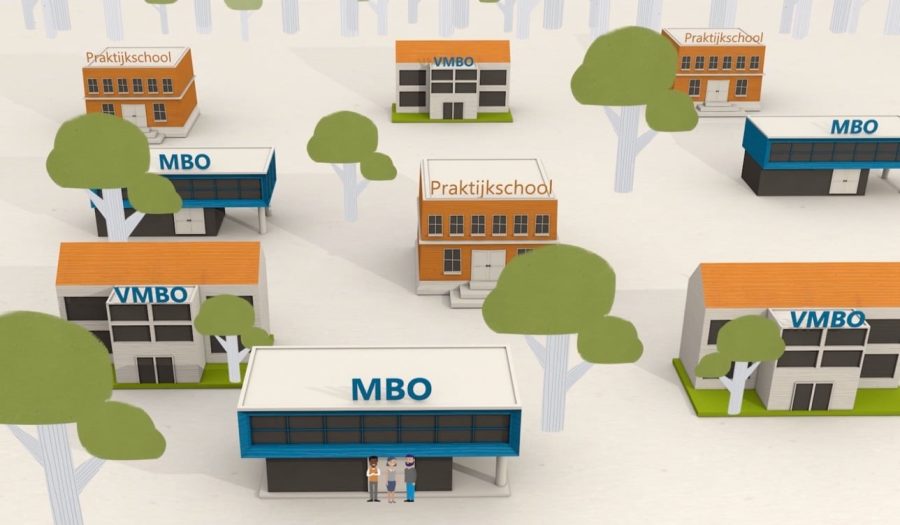
Last year, our team at Phil & Flo created, amongst other things, a have an explainer animation made to explain a new options timetable for a secondary school. Often, if you structure your animation well, it can serve multiple target audiences — for example, pupils, parents, and teachers alike.
How do I incorporate explanimations into my teaching package?
Een having an explainer animation made is essentially the same as an explainer animation. When you add animation to your teaching package, it is important that these fit in well with the existing teaching materials. It is advisable not to replace teaching materials with animation per se, but rather to supplement them with educational animations. For example, for a mathematics chapter on Pythagoras' theorem. In a playful way, you can create interactive exercises in animation form.
Through making good use of pauses in an animation, not only does the material stick better with the pupils, but the animation also creates space for a question-and-answer session. The role of the teacher naturally remains essential in all of this. As a teacher, you can respond to questions that arise as a result of the animation and address any remaining points of confusion with the whole class.
Education trends in animation
When it comes to the digitalisation of our education system, there is certainly a role to be played by video content and, more specifically, animation. By supplementing lesson content with this (interactive) material, the teaching package becomes more varied, more engaging, and more exciting, whilst also supporting the teacher.
The workload for a teacher decreases when they are able to make use of animations in the teaching package. The animation captures the pupils' attention, instructs them in a new way, and lays the groundwork for a class discussion. This makes lessons more enjoyable for both the teacher and the pupils. And no, this does not solve the staffing shortage in education, but we firmly believe that it can contribute to better working conditions and, in doing so, breathe new life into the teaching profession.
Would you like to find out more about the use of animation in education? Call us now on 085 2738331 for our education specialist.
Or get your Animation video, Have an AI video madeor your whiteboard animation made by our animation specialists.